


Review: a look at the STM32L4R9I-EVAL evaluation board
Motor controller
An interesting — or should I say intriguing? — feature of the STM32L4R9I-EVAL board is Motor Control (MC) connector CN1. Located at the top of the board this 34-pin boxed header provides all the signals to build a three-phase BLDC motor controller with (add power electronics to taste). The MCU does not have a built-in motor controller, but it can generate the necessary PWM signals and measure motor currents.Why do I find this feature intriguing?
First of all, because enabling the connector requires modifying the board in about fifty (!) places. To make this modification a bit easier the User Manual provides drawings of the board’s top and bottom sides with the parts to remove and solder bridges (SB) to brake in red and the solder bridges to make in green, and a table explaining the mods. The second reason is that by enabling the motor controller, many (if not most) of the other peripherals on the board are disabled, including the displays, LEDs and buttons (goodbye user interface).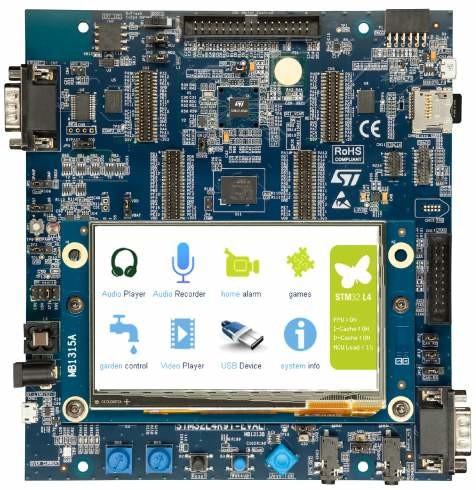
Even though it is possible to try out the STM32L4R9I MCU in motor control applications, doing so by remodelling a two-display smartwatch multimedia evaluation board seems a bit of a roundabout way to get there.
Conclusion
The STM32L4R9I-EVAL is a very complete evaluation board with two displays and loaded with connectivity options. Memory is plentiful and so are configuration possibilities. Because the board is based on an ARM Cortex-M4 core running at 120 MHz, there is enough processing power for state-of-the-art applications like smartwatches, media controllers and also brushless motor controllers (even though this takes a motivated user). Thanks to the abundant communication interfaces and displays the board could even be used as the brains, router or concentrator in another development setting instead of a computer.Free tools
On the software side the kit is supported by System Workbench and the STM32CubeL4 example and demo package containing not only example code for most of the peripherals, but also demos for more advanced applications. Graphics libraries are available from third parties.No external hardware is necessary to program the board or to debug it as an ST-Link/V2-1 programmer/debugger is included on the board.
Some criticism
The weak side of the STM32L4R9I-EVAL kit is its documentation, which is, to say the least, a bit light when it comes to software development. All it says is: “The latest versions of the demonstration source code and associated documentation are available from www.st.com”, and leaves it up to the would-be developer to find it. Let’s hope this will be improved in the near future.Where to buy
The STM32L4R9I-EVAL kit is available from Mouser, ref. 511-STM32L4R9I-EVAL.STM32L4R9I Discovery kit: Mouser ref. 511-STM32L4R9I-DISCO.
Read full article
Hide full article
Discussion (0 comments)